
Phil Toop
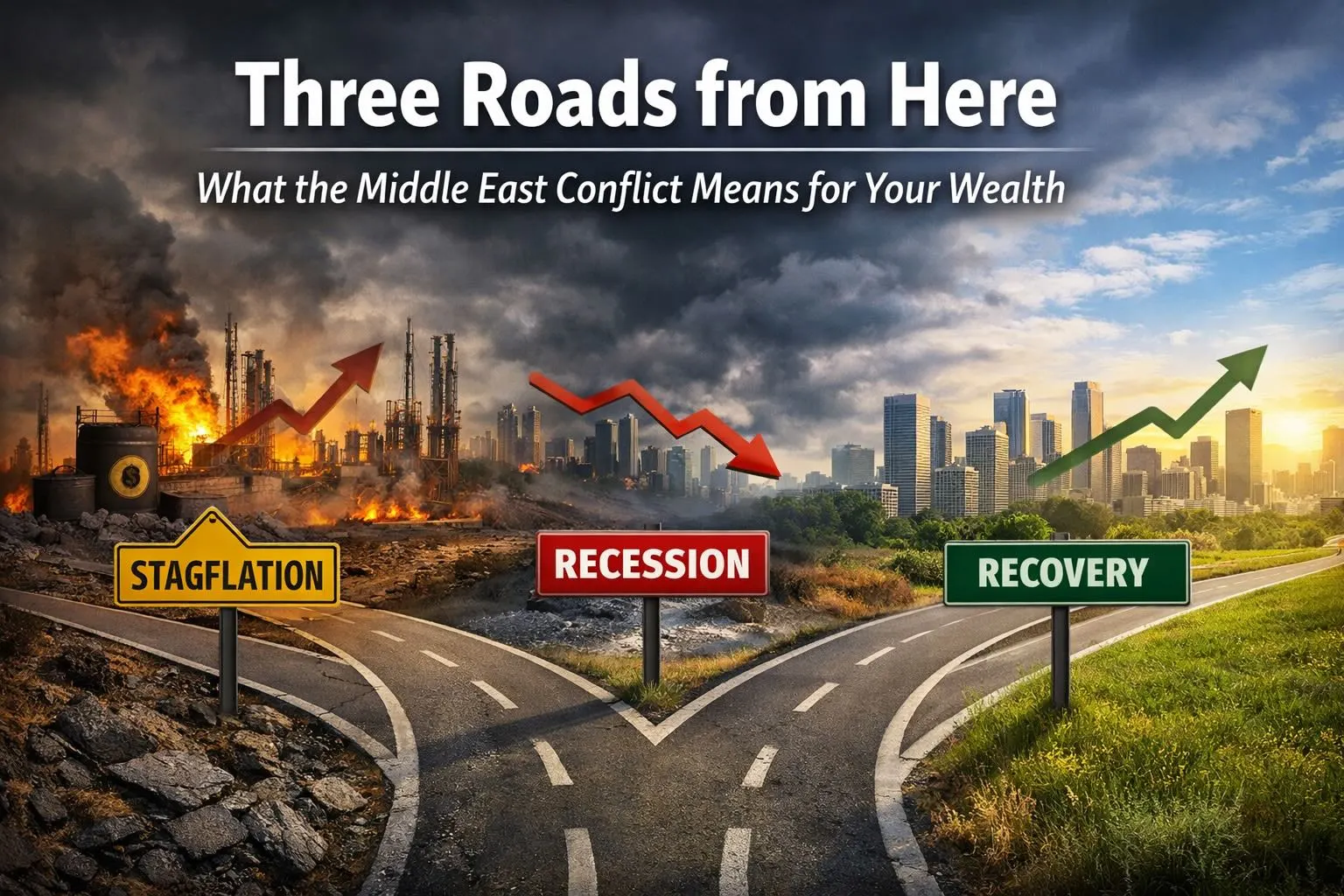
Three Roads from Here
What the Middle East Conflict Means for Your Wealth
Published: March 2026
Audience: General Clients and Investors
Document type: Client Briefing Note
Status: General Information Only
| A note on what this article is and is not
What follows is a structured look at three economic scenarios that could plausibly emerge from the current Middle East conflict. It is not a forecast. Nobody knows how long this conflict will last, whether the Strait of Hormuz will remain disrupted, or what the precise economic consequences will be under each path. Anyone claiming certainty about these questions should be treated with considerable scepticism. The value of scenario thinking is not that it tells you what will happen. It is that it helps you think clearly about what could happen and what the implications would be, so that you are not making decisions under surprise. Laying out three scenarios is not pessimism, and it is not optimism. It is preparation. |
The Situation as at March 2026
The speed at which the world changed in late February 2026 has been genuinely jarring. In the space of a few days, a regional military conflict became a global economic shock, and investors who had been cautiously optimistic about rate cuts and a soft landing suddenly found themselves re-reading their history books about the 1970s.
The US-Israeli war on Iran, which began with airstrikes on 28 February 2026, has done what geopolitical events only occasionally manage to do: it has translated directly into a macro shock. The economic impact has been described as the worst since at least the 1970s, echoing the supply shortages, high oil prices, currency volatility and projections of global inflation that defined that era. The Strait of Hormuz, through which roughly 20 per cent of global oil and gas supplies transit, remains severely disrupted. The International Energy Agency has described the war as creating the largest supply disruption in the history of the global oil market.
Against that backdrop, there are three scenarios that investors and their advisers need to think through carefully: stagflation, global recession, and a return to something closer to normal. None of these is certain. All of them are currently plausible. Understanding the distinguishing features of each, and layering in the pre-existing vulnerabilities in AI infrastructure, SaaS valuations, private credit and private equity, is what good financial planning looks like right now.
The Energy Shock in Numbers
Before examining the scenarios, it helps to have the numbers in front of you.
| Commodity / Indicator | Change Since Conflict Began (as at 12 March 2026) |
| Brent crude oil | +39% (peaked above USD 110/bbl) |
| Dutch TTF natural gas futures | +59% |
| Middle East granular urea (fertiliser) | +34% |
| Global helium supply | Approx. one-third removed from market (Qatar disruption) |
| Capital Economics upper scenario | Brent could average USD 150/bbl over next 6 months |
Source: Deloitte Insights, Capital Economics, World Economic Forum. March 2026.
The disruption is not limited to oil. The strait is a chokepoint for an interlocking web of commodity flows. War-risk insurance has been cancelled or repriced, marine premiums have surged, and freight costs are rising across energy and non-energy trade alike. The helium disruption deserves particular attention: helium is an irreplaceable input in semiconductor manufacturing, and there is no short-term substitute.
Scenario One: Stagflation
THE HARD CASE
This is the scenario that central bankers fear most, and for good reason. Stagflation is the toxic combination of rising inflation and stagnant or declining growth, and it is extraordinarily difficult to manage with conventional monetary policy tools.
Rising oil prices create a risk of stagflation by forcing governments, businesses and families to spend more on energy and reduce spending on other things, slowing economic growth. The policy dilemma is stark: the Reserve Bank and other central banks can either raise rates to fight inflation or cut rates to support growth, but the two problems call for opposite solutions.
History reinforces the concern. Of the seven US-involved Middle East conflicts since 1970, equity markets recovered within the year in six out of seven cases. The one exception was the 1973 Yom Kippur War, where a sustained oil embargo triggered stagflation and a prolonged downturn. The parallel to 1973 is uncomfortable: that conflict also involved a strategic chokepoint, supply that could not easily be replaced, and central banks that were already fighting inflation before the shock arrived.
| The Central Bank Dilemma
Raise rates: slows inflation but deepens the growth contraction, hitting households already under energy cost pressure with higher mortgage costs simultaneously. Cut rates: supports growth but risks entrenching inflationary expectations. The 1970s showed that once expectations become unanchored, the cost of re-anchoring them is severe. Hold: the current base case for most central banks, but works only if the conflict resolves quickly and oil prices normalise. |
What makes the stagflation scenario more likely? A prolonged conflict. Capital Economics has forecast that even if the conflict is contained to three months, Brent crude could average USD 150 per barrel over the next six months. At that level, research by the University of Chicago’s Energy Policy Institute suggests sustained oil prices representing 4 to 5 per cent of GDP have historically always triggered a recession.
Scenario Two: Global Recession
DEMAND DESTRUCTION TAKES HOLD
The recession scenario is distinct from stagflation in that it involves a more decisive collapse in growth, with inflation potentially moderating as demand destruction takes hold. Economists have pointed to the crises of 1973, 1978 and 2008 as evidence that every significant spike in oil prices has been followed in some form by a global recession.
Prolonged conflict risks a global recession, with higher energy costs eroding consumer spending and industrial competitiveness. For China, already facing modest 2026 growth expectations, higher energy costs would feed directly into production costs for steel, chemicals and electronics, squeezing margins and weakening export competitiveness at a moment of intense trade friction.
For Australia, the recession scenario carries particular transmission mechanisms. Higher energy import costs, a weaker Chinese economy reducing demand for our resources, and delayed rate cuts from the RBA all compound. Bond markets have already begun pricing rate rises into the equation for the near term rather than the cuts that were anticipated only weeks ago.
Scenario Three: Ceasefire and Recovery
THE HISTORICALLY NORMAL OUTCOME
The third scenario, which remains genuinely on the table, is that the conflict ends relatively quickly and the global economy absorbs the shock without lasting damage. If the hostilities wrap up in relatively short order, there is little reason for investors to expect a lasting market impact, because the economic impact would not be lasting either.
Capital Economics has noted that if the conflict is short-lived and Iranian attacks on the Strait of Hormuz cease, oil and LNG prices would fall back sharply, with Brent crude potentially reaching USD 65 per barrel by the end of the year. That would be a relatively benign outcome for consumers, central banks and financial markets alike.
The complication is that geopolitical conflicts are notoriously difficult to forecast, and the current conflict has already expanded beyond what most analysts initially anticipated. The honest answer to which scenario will play out is that nobody knows yet, and anyone who claims otherwise is selling certainty that does not exist.
The Three-Scenario Outlook at a Glance
| Scenario | Indicative Probability | Oil Year-End | GDP Impact | Inflation Peak | RBA Path |
| Swift ceasefire
Recovery / Back to normal |
25-35% | ~$65/bbl | Flat to -0.3% | ~3-4% | Rate cuts resume Q3 2026 |
| Prolonged conflict (2-4 months)
Stagflation |
35-45% | $120-$135/bbl | -1.0% to -1.5% | ~5-6% | Cuts suspended; hike possible |
| Extended Hormuz closure (6+ months)
Global recession |
20-30% | $150+/bbl | -2.5% to -3.5% | 7-9% | Policy dilemma; stagflationary trap |
Probability ranges are indicative only, based on Capital Economics, ING, MSCI and AllianceBernstein scenario analysis. Not a forecast. Not personal financial advice.
The Compounding Problem: AI, SaaS and Data Centres
Even before a single drone was launched at a Gulf data centre, there were already serious questions building about the valuations underpinning the technology sector’s AI-driven investment boom.
More than USD 3 trillion is the estimated price tag to build the data centres needed to prepare for the artificial intelligence boom, and not even the world’s biggest technology companies are prepared to foot the bill with only their own cash. Private credit had stepped into that financing gap in a major way. That arrangement is now under pressure from multiple directions simultaneously.
The SaaS sector entered 2026 already grappling with slowing growth rates, increased price sensitivity among enterprise clients, and the existential question of whether AI models would substitute for, rather than complement, software-as-a-service products. Disruption to Gulf data centres compounds these concerns directly.
The drone strikes that damaged three Amazon Web Services data centres in the UAE and Bahrain have put the region’s AI ambitions on ice, disrupting power flows, triggering fires and water damage that will take prolonged work to fix. Standard commercial property and business interruption insurance policies frequently exclude acts of war, meaning companies must aggressively scrutinise their insurance coverage and secure specialised war risk policies that are complex and heavily contested by underwriters.
The helium disruption deserves separate attention. Middle East supply chain disruptions are likely to tighten global helium supply and raise prices, potentially affecting major semiconductor industries in Taiwan, South Korea and Japan. Helium is an irreplaceable input in chip manufacturing, and there is no short-term substitute. If semiconductor production slows, it delays not just consumer electronics but also the AI infrastructure buildout itself, creating a feedback loop that constrains the very investment thesis that has driven markets higher.
Private Credit: The Liquidity Problem Everyone Knew Was Coming
The private credit market had been showing signs of stress even before the conflict began, and the current environment has accelerated the reckoning.
| Indicator | 2021 Level | March 2026 Level | Signal |
| Average borrower interest coverage ratio | 3.2x | 1.5x | Critical |
| Borrowers with negative operating cash flow | ~8% | ~40% | Critical |
| Blackstone BCRED net outflows (Q1 2026) | — | $1.7bn | Elevated |
| Blackstone BCRED capital calls (Q1 2026) | — | $3.7bn (record) | Elevated |
| Blue Owl redemption suspension | None | First in its history | Elevated |
| KBW Nasdaq Bank Index (past month) | — | -20% | Caution |
| Private credit market AUM | ~$900bn | ~$2 trillion | Scale risk |
Sources: Bloomberg, InvestmentNews, Axios. March 2026.
Private credit has grown into a roughly USD 2 trillion market over the past decade, projected to reach USD 4 trillion by 2030, with direct lenders filling the void left by banks after regulatory reform. The scale of the market means that stress does not stay neatly contained.
The liquidity mismatch at the heart of private credit is the central risk. Many funds promise quarterly redemptions, but the fine print reveals gates, side pockets and suspension clauses that matter when investors need the cash. For Australian retail investors who were sold these products on the basis of attractive yields and apparent stability, the current environment is the first real test of what those liquidity constraints mean in practice.
Private Equity: The Exit Problem
Private equity entered 2026 with an accumulation of problems that the conflict has made significantly worse. The asset class relies on the ability to exit investments within a defined timeframe, typically five to seven years, at valuations that justify the original acquisition price. Both conditions are currently compromised.
The private equity and private credit dilemma involves large amounts of capital and debt tied up in businesses that may now not be worth as much as they were two years ago. A few of the big US private equity players have share prices off 40 per cent or more, with alternative asset manager Blue Owl off approximately 60 per cent. The exit market depends on either IPO windows or strategic buyers, both of which require confidence, liquid markets and accessible financing. None of those conditions are present in March 2026.
The backlog of unrealised assets sitting on private equity balance sheets will become an increasing source of pressure on fund performance metrics, on distributions to investors, and on the valuations reported in managed portfolios that hold these assets at marks that may not reflect current market conditions.
The Elephant in the Room: Donald Trump
Any honest analysis of the three scenarios laid out in this article has to confront the fact that one variable sits above all others in determining which path the world takes. That variable is not oil supply, central bank policy, or even Iranian military capability. It is the decision-making of the President of the United States.
Donald Trump is, as CNBC’s analysis put it, singlehandedly shaping the course of global events to a degree that far outstrips even the power he wielded in his first presidency. His decisions about the Iran war will singlehandedly determine much of the economic outlook. This is not partisan commentary. It is the structural reality of the situation, and it is the single most important reason why the scenario analysis in this article carries unusually wide probability ranges.
How We Got Here
The decision to launch joint US-Israeli airstrikes on Iran on 28 February 2026 was made in a planning environment that, by multiple accounts from within the administration, was less rigorous than normal. The White House had sharply downsized its National Security Council over the prior year, removing the coordinating function that typically stress-tests war planning across government agencies. According to reporting by CNN, Trump officials weighed the possibility that Iran would close the Strait of Hormuz but underestimated Tehran’s willingness to do it.
At the war’s outset, Trump said it would last days. Then weeks. He subsequently said he was not interested in a ceasefire. As of the date of writing, he has signalled he is considering winding down military operations, but notably without reopening the Strait of Hormuz, which would leave the global economic disruption largely unresolved. As Axios noted, it would be an extraordinary step to withdraw without solving a major economic crisis that resulted from the war.
The Political Incentives Pulling in Both Directions
There is an important reason to think Trump may ultimately move toward de-escalation, even if not in a straight line. He entered 2026 with economic wind at his back: falling mortgage rates, relatively low inflation, and cheap oil. The war has materially undermined all of that. Consumer prices, mortgage rates and energy costs have all moved in the wrong direction for a president whose core political brand rests on economic management.
Before the conflict, just 40 per cent of Americans approved of Trump’s handling of the economy. That was before gas prices surged by more than 65 cents a gallon. Republican members of Congress, facing midterm elections in November 2026, are privately and publicly urging him to find a way out. History is also instructive: when a significant stock market correction in spring 2025 followed his initial aggressive push on tariffs, Trump moved to moderate his position. The stock market has historically been the feedback mechanism that most reliably influences his economic decisions.
At the same time, Trump has declared that the war will not end until Iran surrenders unconditionally, a position that Iran is not remotely close to adopting. There is also a growing divergence between US and Israeli objectives. As CNN reported, Israeli officials privately acknowledge that Trump’s political timeline is considerably shorter than Netanyahu’s. One Israeli official said directly: there is no doubt that his political clock is shorter and sharper than ours.
The Tariff Precedent and What It Tells Us
The tariff episode of 2025 offers the clearest available evidence of how Trump’s economic decision-making operates under pressure. Aggressive tariffs were announced, markets fell sharply, financial and political pressure built, and a moderation followed. The pattern was not a smooth policy process. It was reactive, headline-driven, and ultimately responsive to market and political feedback rather than to a preconceived strategic plan.
The Iran conflict appears to be following a similar dynamic, at a far higher level of consequence. Trump has publicly dismissed the economic impact of rising energy prices, posting on Truth Social that short-term oil prices are a very small price to pay for safety and peace. White House aides and cabinet officials are simultaneously under intense pressure to reverse the spike in energy prices. Those two positions are in tension, and the resolution of that tension will largely determine which of the three economic scenarios materialises.
What This Means for Scenario Probabilities
| The Trump Variable: Key Questions to Watch
Whether Trump frames a ceasefire or wind-down as a victory rather than a retreat. His historical pattern is to declare success regardless of the underlying facts, which creates a plausible off-ramp. Whether the stock market declines further. The spring 2025 tariff episode showed this is his most reliable feedback mechanism. Whether Republican pressure on midterm election prospects intensifies. Congressional members facing tight races have already begun publicly calling for an exit strategy. Whether the Strait of Hormuz reopens. A wind-down that leaves the strait disrupted would leave the economic shock running without a resolution, which markets would likely price very negatively. Whether the US-Israel objective divergence widens. If Netanyahu pursues objectives beyond Trump’s political timeline, the alliance dynamic could shift in ways that accelerate or complicate an exit. |
The honest summary of the Trump variable is this: the recovery scenario becomes more likely if Trump finds an exit he can frame as victory, which his political incentives are increasingly pushing him toward. The stagflation or recession scenario becomes more likely if the conflict drags beyond his ability to control the narrative, or if the gap between his public posture and the underlying military and diplomatic realities widens further.
For Australian investors, the practical implication is that this situation is more susceptible to rapid reversal than a conventional geopolitical crisis, precisely because it ultimately depends on the decisions of a single individual whose positions are heavily influenced by real-time political and market feedback. That is not reassuring in the conventional sense. But it does mean that the tail outcomes, both positive and negative, can materialise faster than historical analogies might suggest.
What This Means for Australian Investors
Australia is not immune, but it is not the most exposed developed economy either. We are a net energy exporter, which provides some buffer. Asia’s outlook is underpinned by stronger growth in India, Singapore and Australia. But higher oil prices and a firmer US dollar pose meaningful downside risks, delaying the easing cycle.
The key transmission mechanisms for Australian investors are: energy import costs feeding domestic inflation; reduced Chinese growth reducing demand for Australian resources and affecting equity valuations; rising insurance and shipping costs feeding through to consumer prices; and the private credit and private equity exposures that have been increasingly marketed to Australian investors as alternatives to listed markets.
The question of whether your portfolio is positioned for stagflation, recession or recovery is not a binary choice between optimism and pessimism. It is a question about scenario weighting, diversification, liquidity and the realistic distinction between assets that are marked at fair value versus those that may be carrying embedded losses that have not yet been recognised.
What Behavioural Finance Tells Us About Right Now
Understanding the macro scenarios is one thing. Understanding how our own psychology responds to them is arguably more important for long-term investment outcomes. Several well-established behavioural biases are operating powerfully in this environment.
The Availability Heuristic: We Overestimate What We Can See
The availability heuristic causes us to weight the probability of an event by how vividly we can picture it. Drone strikes on data centres, oil at USD 120 a barrel, queues at petrol stations: these images stick. The statistical reality is that in six of the seven US-involved Middle East conflicts since 1970, markets recovered within the year. That dry fact competes poorly with the footage on the news. This does not make the footage irrelevant. It means you should actively correct for the distortion it creates.
Ambiguity Aversion: Uncertainty Feels Worse Than Risk
There is a well-established distinction in decision science between risk, where we do not know the outcome but we know the odds, and ambiguity, where we do not know the outcome and we do not know the odds either. The current conflict sits firmly in the ambiguity category. Nobody knows when it will end. Nobody knows how far it will spread. The rational response to ambiguity is not to assume the worst case. It is to maintain positions that are resilient across multiple outcomes and to resist the urge to bet the portfolio on a single scenario.
Loss Aversion: Most Dangerous at Market Lows
Kahneman and Tversky’s finding that losses feel roughly twice as painful as equivalent gains is one of the most replicated results in all of psychology. It creates a powerful and entirely understandable impulse to sell when portfolios are falling. The problem is that this impulse is typically strongest at exactly the point where long-term investors should be doing the least. Selling into a geopolitically driven downturn locks in losses and creates the much harder subsequent problem of deciding when to re-enter.
The Narrative Fallacy: False Certainty in Complex Situations
Humans are story-making creatures. Presented with a genuinely uncertain situation, we tend to construct a single coherent narrative and then treat it as more probable than the evidence warrants. The financial media has a structural incentive to pick the most dramatic narrative and present it with confidence. The honest position in March 2026 is that three materially different economic outcomes are all plausible, their probabilities are genuinely uncertain, and anyone offering a confident single forecast deserves your scepticism rather than your trust.
Action Bias: Doing Something Feels Like Prudence
Research on decision-making under pressure consistently shows that people feel a compulsion to do something when the environment is threatening, even when inaction is the statistically superior response. For investors, this manifests as portfolio reshuffling, redemptions, or switching to cash at the worst possible moment. The discipline of doing nothing, or doing very little and very deliberately, is psychologically hard but often financially correct. That is not the same as ignoring your circumstances. If your portfolio carried genuine illiquidity risks in private credit or private equity before this conflict, addressing those is a considered response. Selling your listed equity portfolio because markets are down 8 per cent is not.
A Note for Neurodivergent Readers
| If you are neurodivergent and are finding the current environment more distressing than previous volatile periods, that response is neither irrational nor unusual. Research is clear that elevated intolerance of uncertainty is a feature of many neurodivergent neurotypes, and the current situation is characterised precisely by the kind of unresolvable ambiguity that activates that trait most acutely. The most useful things you can do right now are to limit your news consumption to deliberate, time-bounded intervals; to contact your adviser and ask for a concrete plan with specific review dates; and to be honest with yourself and your adviser about how you are actually experiencing this. If you would like to speak with us about your specific situation, please reach out. |
Historical Reference: Major Oil Shocks Since 1973
| Episode | Trigger | Oil Price Change | US CPI Peak | GDP Impact | Outcome |
| 1973-74 | Yom Kippur War / OAPEC embargo | +300% | 11.0% | -3.2% | Stagflation (prolonged) |
| 1979-81 | Iranian Revolution + Iran-Iraq War | +133% | 14.5% | -2.5% | Stagflation (prolonged) |
| 1990-91 | Gulf War (Iraq invades Kuwait) | +80% | 6.3% | -0.2% | Mild recession; fast recovery |
| 2002-08 | Iraq War + China demand surge | +450% | 5.6% | -4.3% (GFC) | GFC recession (compounded) |
| 2022 | Russia-Ukraine War | +60% | 9.1% | +2.1% | Inflation / soft landing |
| 2026 (so far) | US-Israel War on Iran; Hormuz disruption | +39% (and rising) | TBD | TBD | Unresolved |
Sources: Federal Reserve History, IEA, MSCI Research, Deloitte Insights, Capital Economics, Bloomberg. GDP change figures are for the United States. The 2002-08 oil price change reflects the full run-up; the GFC was the primary driver of the GDP contraction.
Of the six completed oil shock episodes since 1973, only two produced sustained stagflation: 1973-74 and 1979-81. Both shared three features absent in milder shocks: a disruption that could not be quickly reversed; a central bank that was either behind the curve or structurally limited in its response; and pre-existing inflationary pressure before the shock landed. All three of those features are present in March 2026. That is cause for vigilance, not panic.
Conclusion: Three Scenarios, Genuine Uncertainty, One Discipline
Let us be direct about what this article has and has not done. It has laid out three scenarios that represent meaningfully different economic futures. It has grounded those scenarios in the best available research. It has highlighted the compounding vulnerabilities in private credit, private equity, AI infrastructure and semiconductor supply chains that make this shock more complex than a straightforward energy price event.
What it has not done is tell you which scenario will eventuate. That is not a gap in the analysis. It is the honest acknowledgement that this is genuinely unknowable at the time of writing. The conflict is three weeks old. Diplomatic channels are active. Military conditions on the ground are shifting. These are not rhetorical possibilities added for balance. They are the genuine state of uncertainty that confronts every investor, every central bank, and every government right now.
The purpose of scenario thinking in this environment is to short-circuit the psychological impulse to latch onto the most vivid narrative, almost always the worst one, and treat it as inevitable. The historically grounded position is that recoveries from geopolitical shocks are the norm, that stagflation at the scale of the 1970s requires a specific and sustained set of conditions, and that the outcome will depend heavily on variables that are not yet determined.
What investors can control is their preparation: the liquidity of their holdings, the diversification of their exposures, their understanding of the fine print in any illiquid product they hold, and their own emotional response to a market environment that is designed, in the short term, to be extremely uncomfortable.
| The discipline that matters
The discipline of holding a clear, well-diversified strategy through periods of genuine uncertainty is not passive or complacent. It is the evidence-based response to a situation where the honest answer to what will happen is that nobody yet knows. Please contact your adviser if you would like to discuss how any of these scenarios relate to your specific circumstances. |
General Information Disclaimer
This article is general in nature and does not constitute personal financial advice. It has been prepared by Dorset Wealth Management for informational purposes only. Past performance is not a reliable indicator of future performance. Scenario probability ranges are indicative only and are not forecasts. Any decision to act on the basis of this information should only be taken after obtaining appropriate personal financial advice having regard to your individual circumstances, financial situation, needs and objectives. Dorset Wealth Management holds an Australian Financial Services Licence.